
The Best SEO Strategy for Educational Websites in 2026
Education has moved online faster than almost any other industry, and the competition for student attention has never been tougher. Schools, coaching institutes, universities, and EdTech platforms are all fighting for the same search results, which is why having a solid SEO strategy for educational websites is no longer optional — it is the difference between being found and being forgotten.
In 2026, search engines reward websites that are fast, helpful, trustworthy, and genuinely built around what students and parents are searching for. This guide breaks down the best SEO strategy for educational websites this year, step by step, so you can plan your own roadmap or hand it over to a specialist team like HM Digital Solution, a digital marketing agency that has already helped education brands such as EME Academy grow their organic visibility.
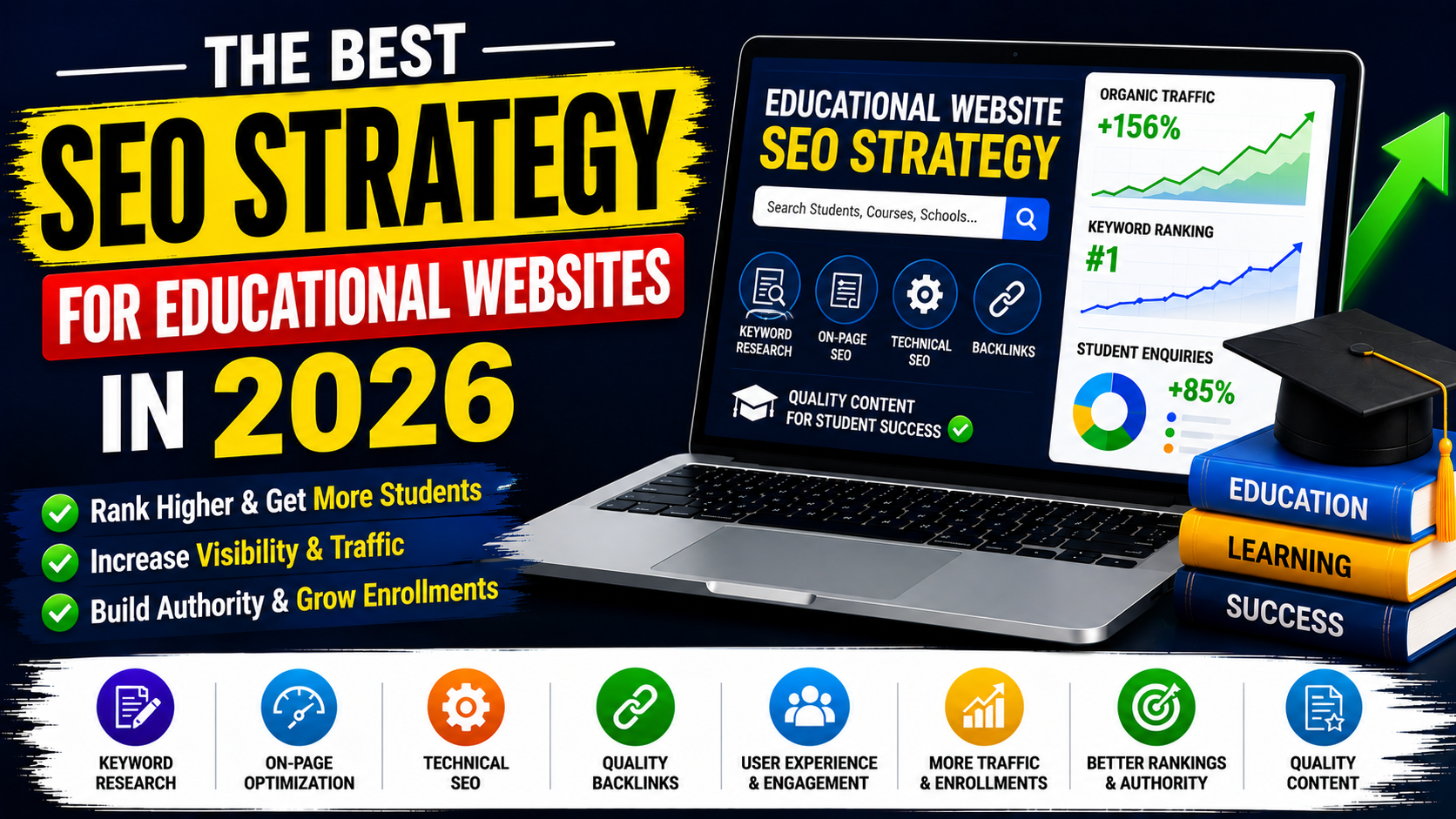
Why Educational Websites Need a Dedicated SEO Strategy in 2026
Education searches are different from typical commercial queries. A parent searching for “best CBSE school near me” or a student typing “online digital marketing course with certificate” has very specific intent, and Google increasingly favors pages that answer that intent precisely.
A generic, one-size-fits-all approach rarely works for institutions. An effective SEO strategy for educational websites must account for seasonal admission cycles, location-based searches, course-specific landing pages, and a growing share of voice and AI-generated search results. Without a structured plan, even high-quality institutions can be buried under aggregator sites, directories, and better-optimized competitors.
Step 1: Start With Keyword Research Built Around Search Intent
Every strong SEO strategy for educational websites begins with understanding how students, parents, and professionals actually search. Group your keywords into three buckets:
- Informational — “how to choose a college,” “best career after 12th science”
- Navigational — your institution’s name, course names, brand terms
- Transactional — “admission form 2026,” “apply for MBA online,” “fees for diploma course”
Tools like Google Keyword Planner, Ahrefs, and SEMrush can help you find these terms, but the real value comes from mapping each keyword to the right page on your site. A trained agency like HM Digital Solution’s SEO services team typically starts every education project with this exact mapping exercise before touching a single page.
Step 2: Optimize On-Page Elements for Course and Admission Pages
Once keywords are mapped, the next layer of any SEO strategy for educational websites is on-page optimization. This includes:
- Writing unique, keyword-focused title tags and meta descriptions for every course, department, and admission page
- Using one clear H1 per page and a logical H2/H3 structure that mirrors how students browse (eligibility, fees, syllabus, career scope)
- Adding descriptive alt text to brochures, faculty photos, and infographics
- Internal linking between related courses, blog articles, and admission pages so visitors and search engines can navigate the site easily
HM Digital Solution’s on-page SEO services focus heavily on this layer because course pages with thin or duplicate content are one of the biggest ranking blockers for schools and universities.
Step 3: Fix the Technical Foundation First
No SEO strategy for educational websites survives contact with reality if the technical foundation is broken. Education sites built on outdated CMS platforms or stuffed with unnecessary plugins often suffer from:
- Slow loading speed, especially on mobile, where most students browse
- Poor Core Web Vitals scores
- Broken internal links after repeated content updates each admission season
- Duplicate content across multiple campus or branch pages
A technical audit should check crawlability, XML sitemaps, structured data (especially Course and EducationalOrganization schema), HTTPS, and mobile responsiveness. HM Digital Solution’s technical SEO services include exactly this kind of audit, which is often the fastest way to unlock ranking improvements that content alone cannot fix.
Step 4: Don’t Skip Local SEO for Schools and Coaching Institutes
If your institution serves a specific city or region, local visibility matters as much as national rankings. A complete SEO strategy for educational websites in 2026 should include:
- A fully optimized Google Business Profile with accurate timings, photos, and reviews
- Location-specific landing pages for each campus or branch
- Consistent name, address, and phone (NAP) details across directories
- Genuine student and parent reviews, which heavily influence local trust signals
This is exactly where HM Digital Solution’s local SEO services add value, helping coaching centers and schools dominate “near me” searches in their own neighborhoods.
Step 5: Build Authority With Helpful, E-E-A-T Driven Content
Google’s emphasis on Experience, Expertise, Authoritativeness, and Trust (E-E-A-T) is especially relevant to education, since the content directly affects real decisions about careers and money. A content-led SEO strategy for educational websites should include:
- Blog articles answering genuine student questions (career guidance, exam tips, course comparisons)
- Faculty bios that highlight real qualifications and achievements
- Case studies or success stories of alumni and placements
- Regularly updated content, since outdated fee structures or syllabus details quickly erode trust
HM Digital Solution’s content writing services are designed to produce exactly this kind of authoritative, student-focused content, which supports both SEO and admissions.
Step 6: Strengthen Off-Page SEO and Education-Specific Backlinks
Backlinks remain a strong ranking factor, but quality matters far more than quantity. For institutions, relevant link-building opportunities include:
- Guest contributions on education portals and career-guidance blogs
- Listings on trusted university and course directories
- Partnerships with alumni blogs, news outlets, and local business associations
- Digital PR around events, scholarships, or placement achievements
HM Digital Solution’s off-page SEO services focus on building these kinds of niche-relevant links rather than chasing irrelevant, low-quality directories that can do more harm than good.
Step 7: Prepare for AI-Powered Search in 2026
AI Overviews and conversational search are reshaping how students discover institutions. To stay visible, your SEO strategy for educational websites should also:
- Structure content with clear, direct answers near the top of each page
- Use FAQ sections that mirror real voice and chat-based queries
- Implement FAQ and Course schema so AI tools can easily parse your content
- Keep statistics, fees, and dates current, since AI-generated summaries often pull the most recently verified information
Institutions that adapt early to this shift will capture attention even when students never click past the AI-generated answer.
Measuring What Matters
A strategy is only as good as its measurement. Track organic traffic to admission pages, keyword rankings for priority courses, conversion rate on application forms, and local pack visibility. Reviewing these metrics monthly allows you to adjust your SEO strategy for educational websites before an entire admission cycle is affected.
Final Thoughts
The best SEO strategy for educational websites in 2026 blends precise keyword targeting, clean technical foundations, location-aware optimization, authoritative content, and readiness for AI-driven search — all working together rather than in isolation. Institutions that treat SEO as an ongoing process, not a one-time project, will consistently outperform competitors who only think about it during admission season.
If you would rather have specialists handle this for your school, college, or EdTech platform, the team at HM Digital Solution offers tailored SEO services built specifically around education-sector goals, from keyword research to technical audits and content creation. You can explore their full range of services or get in touch to discuss a strategy suited to your institution.